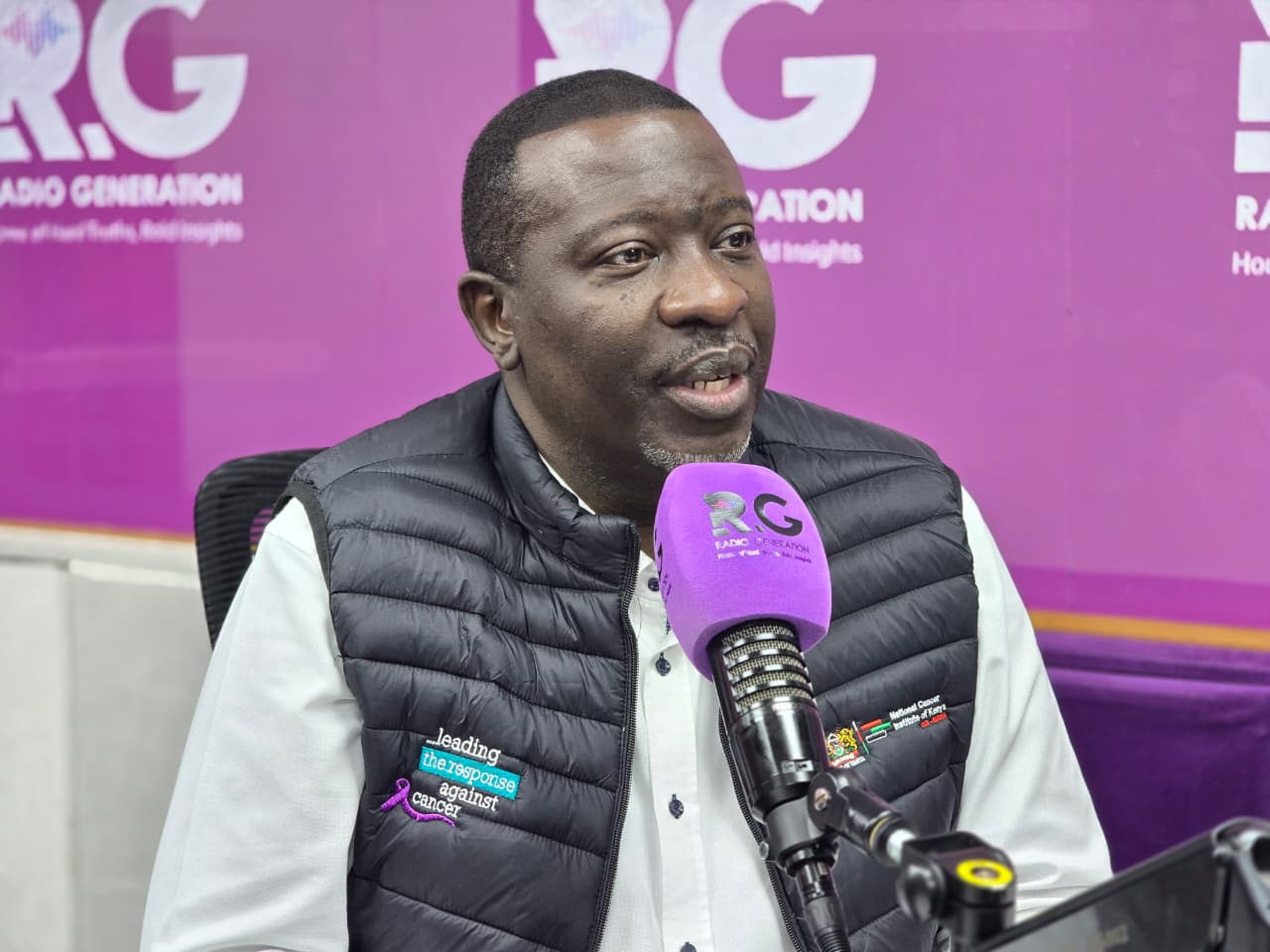
National Cancer Institute Chairperson, Dr. Timothy Olweny, has called for a major shift in how Kenya approaches cancer care and insurance, arguing that the country must stop treating the disease as a single medical problem.
Speaking during an interview on Radio Generation on Friday, Dr. Olweny said the public often misunderstands the scale and complexity of cancer, despite the fact that medical knowledge is now shared globally faster than ever before.
“One of the things people don’t understand is that in this day and age, the dispatch of knowledge is very fast,” he said. “It’s not like in the 80s and 90s when technology developed in the so-called developed countries and took years to get here. Our specialists train in those countries and keep updating their information, so the resources and expertise are available.”
He explained that referring to cancer as though it were a single condition is misleading. “Cancer is actually a group of 100 to 200 diseases,” he said. “Anything in your body that divides can potentially develop cancer. So when we say cancer has become a huge problem, we must understand it is these 200 diseases that have become a huge problem not one.”
According to Dr. Olweny, this complexity affects everything from training to treatment. He noted that cancer can develop in nearly every part of the body except dead tissues like nails, hair and tooth enamel.
“The more rapidly a cell divides, the more likely it is to develop cancer because things can go wrong,” he said. “Yet most of the time, everything works perfectly, and we take that for granted.”
On health financing, Dr. Olweny said Kenya’s new social health insurance framework must reflect the reality that different cancers require different interventions and dramatically different costs.
“We can’t have blanket compensation, one figure for all these diseases,” he said. “We need to break down each individual disease and assign a clear tariff.”
He suggested starting with the country’s “Big Five” cancers, breast, cervical, prostate, colorectal, and anal, which together make up roughly half of all cases. According to him, targeted prevention, proper management, and adequate compensation for these five alone could significantly reduce the financial strain faced by patients.
Dr. Olweny pointed out that the current flat-rate approach often works against patients. Some exhaust their entire benefit “before they even get a diagnosis,” while in other cases, the allocated amount is “actually excessive depending on the type and stage of cancer.”
He urged policymakers to deepen consultations with medical stakeholders, warning that meaningful progress will require Kenya to finally confront the true complexity of cancer.